Refrigerator Repair
Single Evaporator Refrigerator: How It Fails
A single evaporator refrigerator cools both compartments from one coil in the freezer, with a fan and damper sharing the cold air. Here's how it fails.
Written byElena Sandoval
- Role
- Refrigeration technician — cabinet, door and seal work
- In the trade
- 24 years in the trade
- Certification
- EPA 608 certified
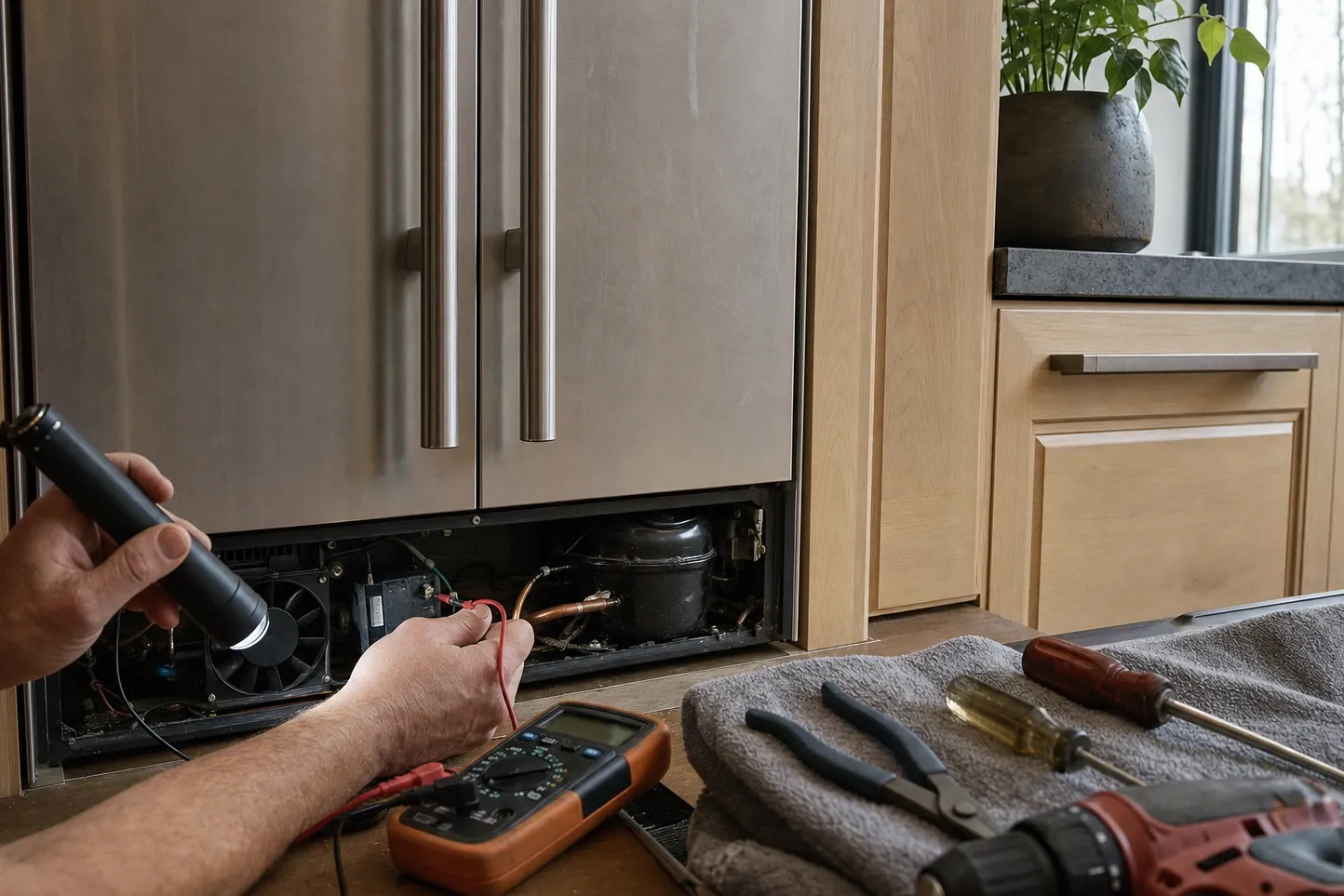
A single evaporator refrigerator produces all of its cold at one finned coil, normally hidden behind the rear panel of the freezer, and a small fan pushes a measured share of that air through a duct and damper into the fresh-food compartment. Both sides lean on that one coil, one fan and one defrost circuit. So when anything in that chain weakens, the refrigerator section warms first while the freezer still feels solid, which is the exact pattern most Los Angeles owners describe when a fridge has stopped cooling.
What the one coil does all day
The compressor sends refrigerant into the evaporator, where it boils far below freezing and soaks up heat from the air drawn across the fins. The evaporator fan is the delivery system: it pulls air from both compartments over the coil and blows it back out, with most going to the freezer and a smaller portion routed to the refrigerator. A damper, either a motorized flap or a simple adjustable baffle, decides how much the fresh-food side receives. Temperature sensors report to the control, which runs the compressor and fan to match. Because the coil is so cold, moisture in the air freezes onto it, so a heater melts that frost at intervals and the water drains to a pan under the cabinet, where it evaporates.
Single coil or two: what changes in the kitchen
One evaporator means fewer parts, lower cost and simpler repairs, which is why it remains the usual design in standard refrigerators. The trade-off is shared air. Air returning from the fresh-food side crosses a coil cold enough to strip out its moisture, so produce dries faster and the smell of a cut onion can end up in the ice. Sub-Zero built its name on the other approach: its full-size built-ins use dual refrigeration, giving each section its own cooling system so humidity and odors stay apart. Compact undercounter combinations, wine storage and freezer drawers can be laid out differently, so the manual for your specific unit is the place to confirm which arrangement sits in your kitchen.
How the parts around the coil wear out
- Evaporator fan motor. Bearings dry out, and the motor squeals, then slows, then quits. Ice growing around the blade can stall it as well.
- Defrost heater, defrost thermostat or sensor. If the heater never switches on, frost keeps layering until the coil is a white block that air cannot pass through.
- Damper. Stuck shut, it starves the refrigerator; stuck open, it can freeze lettuce and milk.
- Thermistor. A sensor reporting the wrong temperature leads the control to run everything at the wrong times.
- Defrost drain. When the drain tube freezes or clogs, meltwater spills into the cabinet, turning to ice on the freezer floor or dripping under the crisper.
- The coil itself. A leak in the evaporator is uncommon, and it is sealed-system work.
What you will notice first
Common signs and their usual causes:
| Symptom in your kitchen | Most likely cause |
|---|---|
| Freezer cold, refrigerator warm | Frosted coil, stalled fan or closed damper |
| Even white frost across the freezer’s back wall | Defrost heater or its thermostat |
| Squeal or ticking from inside the freezer | Evaporator fan motor, or ice on the blade |
| Water pooling under the crisper drawers | Frozen or blocked defrost drain |
| Lettuce freezing at a normal setting | Damper stuck open or a faulty sensor |
In Venice and Playa Vista, where the marine layer keeps the air damp, every door opening carries extra moisture to the coil, so a tired defrost system can show itself sooner near the coast.
Sub-Zero codes that point at the evaporator side
On some Sub-Zero models EC 06 means the evaporator thermistor has read open or shorted for 10 or more seconds. An EE code flashing alongside the Service light or wrench icon marks a failed thermistor too: letters on the left of the display blame the freezer probe, on the right the fresh-food probe, and Sub-Zero offers no owner fix. On certain built-ins the fan codes tell the two coils apart: 35 F 33 or 35 F 34 flags the fan serving the freezer coil, while 35 r 34 flags the one serving the fresh-food coil, so those units carry one coil per side. For a fan code, switch the breaker off for 30 seconds and back on; if it returns, note the code and both temperatures before you ring us.
What you can do, and where it stops
Start with the safe checks. Make sure food is not blocking the vents on the freezer’s back wall and that both doors seal fully. Keep the grille at the base free of dust and lint, and clean the condenser coil a few times a year, as USDA food-safety guidance advises; Sub-Zero notes a unit under 6 months old does not need it. Our toe-kick condenser cleaning walkthrough covers undercounter models. A full manual defrost can clear a frozen coil for a while, but frost that comes back means a defrost part has failed. Sub-Zero also points out that once the fresh-food side reads above 48 degrees with the dial at 38, cleaning by itself rarely brings it back, so that is the moment to book a visit.
Why sealed-system work stays with a technician
Sub-Zero’s current manuals carry a flammable-refrigerant warning and reserve any work on the system for technicians who have had training in handling it. The charge is small as well: under the UL 60335-2-24 standard the EPA adopted in 2018, each circuit using R-600a, R-290 or R-441A may contain no more than 150 grams, about 5.29 ounces. Restoring that amount precisely after a coil or compressor repair takes recovery equipment and an accurate scale. Fan motors and defrost parts sit behind interior panels and wiring harnesses, so those are technician jobs too, even though the risk is lower.
Typical repair costs in Los Angeles
These are typical spreads for this kind of work, and the firm figure follows diagnosis. An evaporator or condenser fan motor usually lands between $310–$680. A defrost heater, thermostat or sensor is about $290–$670 and a door gasket that lets humid air leak in runs $300–$630. Compressor or sealed-system repair sits at $1,300–$3,030 and is the point where weighing a replacement makes sense. Our $89 call-out pays for the drive and a proper diagnosis, then drops off the bill once you approve the work. Homeowners from Woodland Hills to Westwood can arrange a visit through the refrigerator repair page or at (310) 919-2538.
Follow-up questions
What is the best single evaporator refrigerator?
The best one pairs a quiet, easy-to-reach evaporator fan with dependable automatic defrost and a crisper that holds humidity, because those parts decide how well one coil serves two compartments. If you keep a lot of fresh produce, a design with a separate cooling system for each side will hold moisture better than any single-coil layout.
Why is my refrigerator warm when the freezer is still cold?
In a single-evaporator design, a cold freezer beside a warm fridge nearly always means chilled air is no longer making it through the duct. The usual culprits are a coil choked with frost, an evaporator fan that has stopped, or a damper stuck shut. Move any food pressed against the vents first, then look for thick frost on the freezer's back wall.
What is the difference between Sub-Zero and a normal fridge?
The headline difference is that Sub-Zero's full-size built-ins use dual refrigeration, giving fresh food and frozen food their own cooling systems, while many standard refrigerators share one evaporator between both. Keeping the systems apart holds more humidity on the fresh side and stops freezer air from carrying odors into the ice.
Can I defrost a frozen evaporator coil myself?
Yes, as a test: empty the unit, turn it off at the control or the breaker, prop the doors open and lay towels down for about a day until all the frost is gone. If cooling returns but the frost rebuilds within a few days, the defrost heater, its thermostat or its sensor has failed and needs a technician.
Is a single evaporator refrigerator less reliable?
Not necessarily, since it has fewer parts to fail. The catch is that each part carries more weight: one stalled fan or dead defrost heater warms both compartments at once instead of just one.